
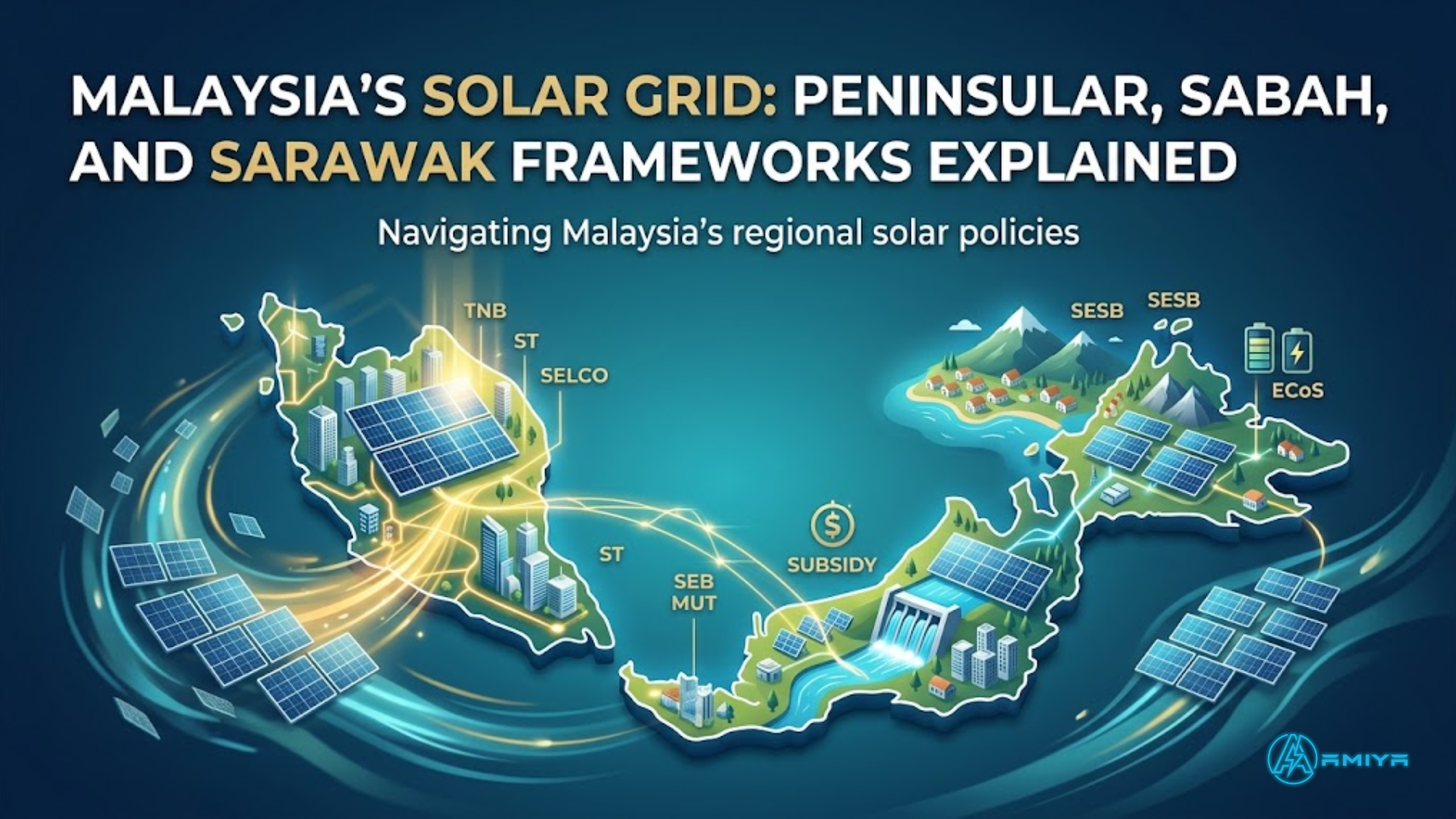
To the uninitiated, navigating the Malaysia solar grid might seem like dealing with a single, unified national network. In reality, the country operates on three distinctly separate grids, each managed by different utility providers and regulatory bodies.
For commercial enterprises and homeowners looking to adopt solar PV systems, understanding the jurisdictional differences across the Malaysia solar grid—specifically between Peninsular Malaysia, Sabah, and Sarawak—is the critical first step to ensuring regulatory compliance and maximizing Return on Investment (ROI).
1. Peninsular Malaysia: The TNB Grid and the Shift to SELCO
Peninsular Malaysia boasts the most mature and rapidly evolving segment of the Malaysia solar grid, driven by a highly industrialized economy.
Utility Provider: Tenaga Nasional Berhad (TNB)
Regulatory Body: Energy Commission (Suruhanjaya Tenaga – ST) & SEDA Malaysia
The 2026 Solar Landscape: Historically, the market was driven by the Net Energy Metering (NEM) quotas (Rakyat, Go, and Nova), which allowed users to export excess energy for grid credits. However, as these quotas reach capacity and baseline tariffs rise, the market has strategically shifted. The most lucrative frameworks today are the Accelerated Transfer Arrangement for Power (ATAP) and Zero-Export Self-Consumption (SELCO), where the financial model prioritizes generating power for pure operational expenditure (OPEX) reduction rather than exporting to the grid.
2. Sarawak: Sarawak Energy and the 2026 Subsidy Boom
Sarawak operates entirely independently from the rest of the Malaysia solar grid, heavily relying on its massive hydroelectric dams. However, rooftop solar is now gaining massive traction under state-led initiatives.
Utility Provider: Sarawak Energy Berhad (SEB / SESCO)
Regulatory Body: Ministry of Utility and Telecommunication Sarawak (MUT)
The 2026 Solar Landscape: A major game-changer for 2026 is the introduction of the Sarawak NEM Solar Subsidy. Sarawak Energy now offers up to RM12,000 for domestic customers installing rooftop solar to encourage clean energy adoption. Installations here require strict compliance and must be executed by EIU-certified (Electrical Inspectorate Unit) contractors. The focus in Sarawak is uniquely balanced between self-consumption and leveraging these highly lucrative, state-specific financial aids.
3. Sabah: SESB, ECoS, and Grid Stabilization
Within the context of the wider Malaysia solar grid, Sabah faces unique geographical and infrastructure challenges compared to the rest of the country, requiring a highly technical approach to solar integration.
Utility Provider: Sabah Electricity Sdn Bhd (SESB)
Regulatory Body: Energy Commission of Sabah (ECoS)
The 2026 Solar Landscape: In January 2024, ECoS officially took over full regulatory authority of Sabah’s electricity supply from the federal Energy Commission. Guided by the Sabah Energy Roadmap and Master Plan 2040 (RAMP 2040), solar adoption via NEM and SELCO Sabah is actively encouraged. However, due to the grid’s unique intermittency limits, applications face stricter technical scrutiny. Battery Energy Storage Systems (BESS) paired with commercial solar are becoming increasingly relevant here to ensure grid stability.
Official References & Regulatory Sources (2026 Updates)
1. Peninsular Malaysia Frameworks:
Suruhanjaya Tenaga (Energy Commission): Official guidelines on electricity supply and SELCO licensing. www.st.gov.my
SEDA Malaysia: Net Energy Metering (NEM) and renewable energy quotas. www.seda.gov.my
2. Sarawak Energy & Subsidy Initiatives:
Sarawak Energy Berhad (SEB): Official documentation on the Net Energy Metering (NEM) Scheme and the RM12,000 Domestic Solar Subsidy. www.sarawakenergy.com/customers/net-energy-metering-scheme
Ministry of Utility and Telecommunication Sarawak (MUT): Electrical Inspectorate Unit (EIU) contractor compliance. mut.sarawak.gov.my
3. Sabah ECoS & RAMP 2040:
Energy Commission of Sabah (ECoS): Official portal detailing the regulatory takeover of Sabah’s electricity supply in January 2024. ecos.gov.my
Sabah Energy Roadmap and Master Plan 2040 (SE-RAMP 2040): The state’s strategic blueprint for energy security and sustainability. Read the SE-RAMP 2040 Document (PDF)