
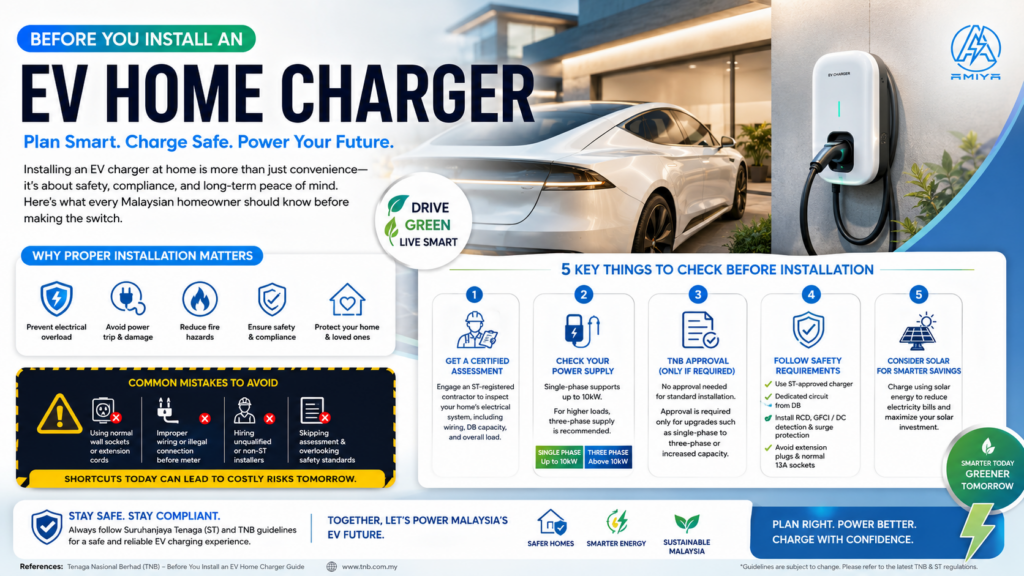
5 Vital Tips: EV Home Charger Malaysia Safe Guide
Are you planning to install an EV home charger Malaysia setup? Electric Vehicles (EVs) are no longer a glimpse into the future—they are actively reshaping how we move. From daily commuting across Johor Bahru to long-distance highway travel, thousands of Malaysian homeowners are making the switch to embrace lower running costs, silent performance, and a zero-emission lifestyle. However, before you bring your new EV home and mount a wallbox in your garage, there is one critical question you must address:
Is your home’s electrical infrastructure actually ready for it?
According to Tenaga Nasional Berhad (TNB) and the Energy Commission (Suruhanjaya Tenaga – ST), proper planning and certified installation are non-negotiable. Here is everything you need to know to ensure your home EV charging setup is safe, efficient, and fully compliant with Malaysian electrical standards.
Why You Should Never Simply “Plug and Charge”
It is a common misconception that an EV charger behaves like any standard household appliance.
Unlike a refrigerator or an air conditioner that cycles on and off, an EV charger draws a continuous, maximum electrical load for hours at a time. Attempting a DIY installation or cutting corners can lead to severe operational issues:
- Grid Overloading: Tripping your main circuit breaker repeatedly.
- Thermal Stress: Overheating cables and standard household wiring.
- Infrastructure Damage: Risk of localized electrical fires or damage to sensitive household electronics.
- TNB Safety Warning: Any unauthorized modifications involving the electricity meter, main incoming fuses, or tapping into power before the meter are strictly illegal, dangerous, and subject to severe penalties.
The Essential First Step: A Certified Electrical Assessment
Before purchasing a wallbox charger, you should appoint an ST-registered electrical contractor or a competent person to audit your home’s existing infrastructure.
The structural inspection and assessment usually include:
- Evaluating the existing wiring condition and age.
- Checking the Distribution Board (DB) capacity.
- Calculating the total maximum demand of the household.
- Verifying the specific power requirements of the chosen charger.
- Determining single-phase or three-phase compatibility.
This audit ensures your property can handle the continuous load without compromising the safety of your household.
Single-Phase vs. Three-Phase: Decoding the Power Supply
Your charging speed is fundamentally limited by the type of electrical supply entering your home. TNB’s official guidelines classify supply capabilities based on total load demand:
| Supply Type | Maximum Supported Load | Best Suited For |
| Single-Phase | Generally supports loads up to 10 kW | Smaller homes, plug-in hybrids (PHEVs), or slower overnight charging. |
| Three-Phase | Recommended for loads exceeding 10 kW | Dedicated high-output home chargers (11 kW to 22 kW) and rapid charging. |
While a single-phase setup can comfortably manage a standard 7.4 kW home charger overnight, installing a higher-output charger or managing multiple high-load appliances simultaneously will likely necessitate a phase upgrade.
Do You Need TNB Approval?
- Standard Wallbox Installation: No direct TNB approval is required if your existing infrastructure can handle the load.
- Supply Infrastructure Upgrades: If your home requires a transition from single-phase to three-phase, or an increase in your designated maximum demand capacity, an official application must be submitted to TNB through an ST-registered contractor.
Core Safety Rules for Your EV Home Charger Malaysia Setup
To safeguard your property and maintain compliance with Malaysian regulations, your installation must meet the following four criteria:
- ST-Approved Equipment: Only install charging units that carry the necessary Suruhanjaya Tenaga and SIRIM approvals.
- Dedicated Isolation Circuit: The EV charger must run on its own dedicated circuit directly from the Distribution Board (DB), completely isolated from other household appliances.
- Advanced Protection Devices: The circuit must be equipped with a Type B Residual Current Device (RCD) or an RCD with a 6 mA DC fault detection mechanism, along with adequate surge protection.
- No Extension Plugs or Standard 13A Sockets: TNB explicitly advises against using standard 13A domestic sockets or extension cords for long-term EV charging due to the high risk of prolonged thermal degradation.
EV Charging + Rooftop Solar: The Ultimate Integrated Energy Ecosystem
For homeowners looking to maximize their investment, pairing an EV charger with a residential rooftop solar system offers the ultimate synergy.
By shifting your primary charging window to peak solar generation hours, you unlock significant long-term advantages:
- Zero-Cost Mobility: Fuel your vehicle directly from the sun, bypassing grid tariffs entirely.
- Maximum Solar Self-Consumption: Ensure that every kilowatt-hour generated by your rooftop panels is utilized on-site rather than fed back to the grid.
- Future-Proof Clean Tech: Transitioning your home into an integrated energy ecosystem—combining solar generation and intelligent EV charging—safeguards your household against evolving energy structures.
Final Checklist for Homeowners
Embracing electric mobility is a powerful step toward sustainable living, but technical precision during setup is key to long-term peace of mind. Before you plug in:
- Verify your home’s existing peak electrical load.
- Engage an ST-registered professional for a physical inspection.
- Select premium, certified charging hardware.
- Explore solar integration to build a highly efficient, self-sustaining energy ecosystem.
Official References & Guidelines
- TNB EV Home Charger Guidelines
- TNB EV Sustainability & Transition Initiative