
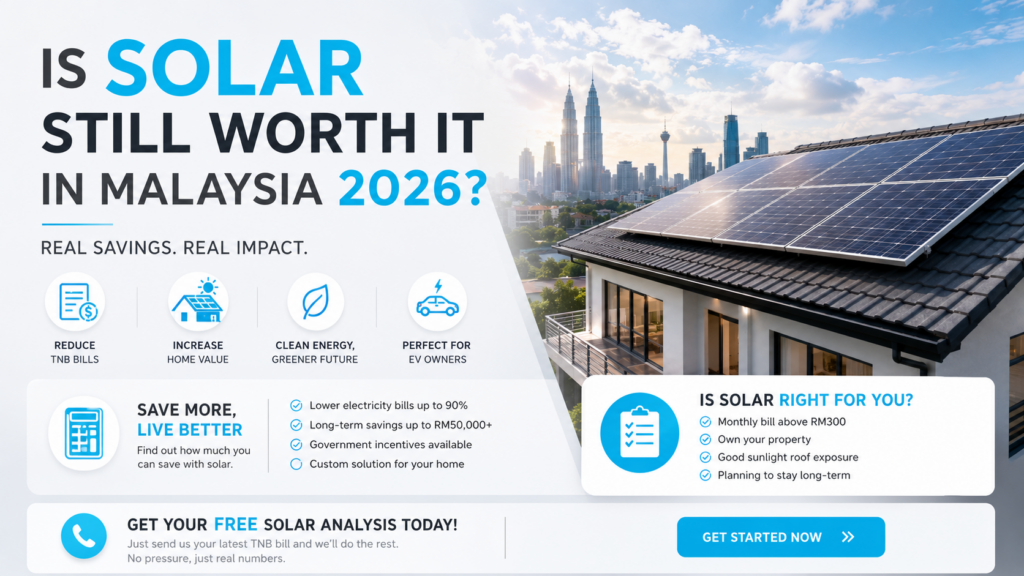
Is Solar Worth It in Malaysia 2026? Costs, Savings & ATAP
Is solar worth it Malaysia 2026? It’s a question more homeowners are asking today, not just because of environmental awareness, but because rising electricity bills are becoming harder to ignore. As household energy consumption increases—especially with the rapid adoption of electric vehicles (EVs)—the role of solar has shifted from being a “green option” to a serious financial strategy.
But the answer isn’t a simple yes or no. Solar is absolutely still worth it in Malaysia today, provided you understand how the modern system works, as the landscape has officially evolved past the old policies.
Here is a realistic look at how solar savings are achieved in 2026, what systems currently cost, and how you can maximize your return on investment.
How Solar Works in Malaysia Today: Goodbye NEM, Hello Solar ATAP
To understand whether solar is worth it today, we have to look at the current energy model. For years, Net Energy Metering (NEM 3.0) played a major role in making solar attractive by allowing homeowners to export excess electricity back to the grid on a 1:1 credit basis.
However, NEM officially closed in 2025. On January 1, 2026, Malaysia introduced the Solar Accelerated Transition Action Programme (Solar ATAP).
What has changed? Under Solar ATAP, you can still export excess solar energy, but the credits are no longer 1:1. Instead, exported energy is credited at retail-linked rates (roughly RM 0.27 to RM 0.37 per kWh, depending on your usage tier).
Because of this policy shift, the smartest financial strategy in 2026 relies heavily on self-consumption. Instead of relying on exporting energy to make your money back, modern solar systems are engineered to maximize daytime usage.
The Golden Rule for 2026: When your panels generate electricity, your home uses that energy directly, offsetting TNB’s highest tariff blocks (which can be up to RM 0.57 per kWh). The more of your own solar energy you consume during the day, the faster your system pays for itself.
Cost of Solar Panels in Malaysia 2026: What Should Homeowners Expect?
Understanding the cost of solar panels is often the biggest barrier for homeowners. While the upfront investment is significant, solar should be viewed as a long-term financial asset rather than a short-term expense.
In 2026, the cost of a premium residential solar setup depends largely on system size and your monthly electricity consumption. Here is a realistic breakdown of what landed homeowners are paying today:
5kW to 6kW Systems (Terrace Houses): Typically costs between RM 18,000 and RM 22,000. Ideal for homes with monthly bills around RM 250 to RM 400.
8kW to 10kW Systems (Semi-D & Bungalows): Usually ranges from RM 24,000 to RM 28,000. Best for homes with monthly bills between RM 500 and RM 900.
While lower-cost options exist, choosing a provider based solely on the cheapest price often leads to underperformance. Two homes with similar capacity systems can experience vastly different results depending on the quality of the inverter, panel efficiency (N-Type monocrystalline is the 2026 standard), and professional roof optimization.
When correctly designed, high-quality systems today generally see a return on investment (ROI) in just 4 to 6 years.
Solar for EV Owners in Malaysia: Smarter Energy for the Future
The massive rise of electric vehicles in Malaysia has introduced a brand new dynamic to household electricity consumption. While EVs reduce your reliance on petrol, they dramatically increase your dependence on the grid. Without careful management, regular home charging can push your TNB bill into the highest tariff brackets.
This is where solar energy shifts from “helpful” to “essential.”
When you combine an EV with a home solar system, increased demand becomes an opportunity:
Sunlight as Fuel: By scheduling your EV to charge during daylight hours, you draw directly from your solar panels instead of the grid.
Optimized Self-Consumption: EVs are essentially massive batteries on wheels. They perfectly absorb the mid-day solar power that you might otherwise export to the grid at a lower rate under the new ATAP rules.
For EV owners in Malaysia, solar is no longer just an add-on; it is a strategic advantage that significantly lowers the total cost of vehicle ownership over time.
The Verdict: Is It Worth the Investment?
So, is solar worth it in Malaysia in 2026? The answer lies in execution. When designed correctly, a solar system is a predictable financial asset that shields you from rising electricity costs.
What has changed in 2026 is not the value of solar, but the way that value is achieved. The focus has firmly shifted from chasing 1:1 grid exports to building household efficiency and maximizing direct self-usage. For homeowners who adapt to this shift—especially those integrating EVs or heavily utilizing daytime air conditioning—solar remains one of the smartest and most practical investments available.
Ultimately, solar in 2026 is no longer about following a green trend. It is about taking definitive control of your long-term expenses. And in that context, solar is not just worth it—it is becoming increasingly difficult to ignore.
Want to know if solar is worth it for your specific home? Get a free, personalized analysis based on your current TNB bill today and see exactly how much you could save under the new 2026 Solar ATAP program.