
The 2026 Malaysian Solar Era: From Selling Energy to Energy Mastery
As of January 2026, the renewable energy landscape has officially matured. The transition from the legacy Net Energy Metering (NEM) era to the dynamic Solar ATAP Malaysia 2026 and Enhanced SELCO frameworks marks a fundamental shift. We are moving away from simply “selling energy” back to the grid and entering the era of true Energy Mastery.
For property owners and stakeholders in the B2B sector, the goal is no longer just putting panels on a roof. It is about aggressively optimizing self-consumption to hedge against fluctuating utility costs, grid instability, and the financial impact of the newly implemented Carbon Tax.
The Catalyst for Change: Why 2026 is the Tipping Point
The shift in national policy is not arbitrary; it is a direct response to global economic pressures and local grid modernization. With the implementation of the Carbon Tax and the gradual restructuring of electricity subsidies, the true cost of grid reliance has never been higher.
For businesses, energy is no longer just an overhead cost—it is a critical risk factor. For homeowners, power independence is rapidly becoming a standard requirement for modern living. The new frameworks are designed to reward those who use their generated power efficiently rather than those who simply export it.
1. Solar ATAP: The Dynamic Successor
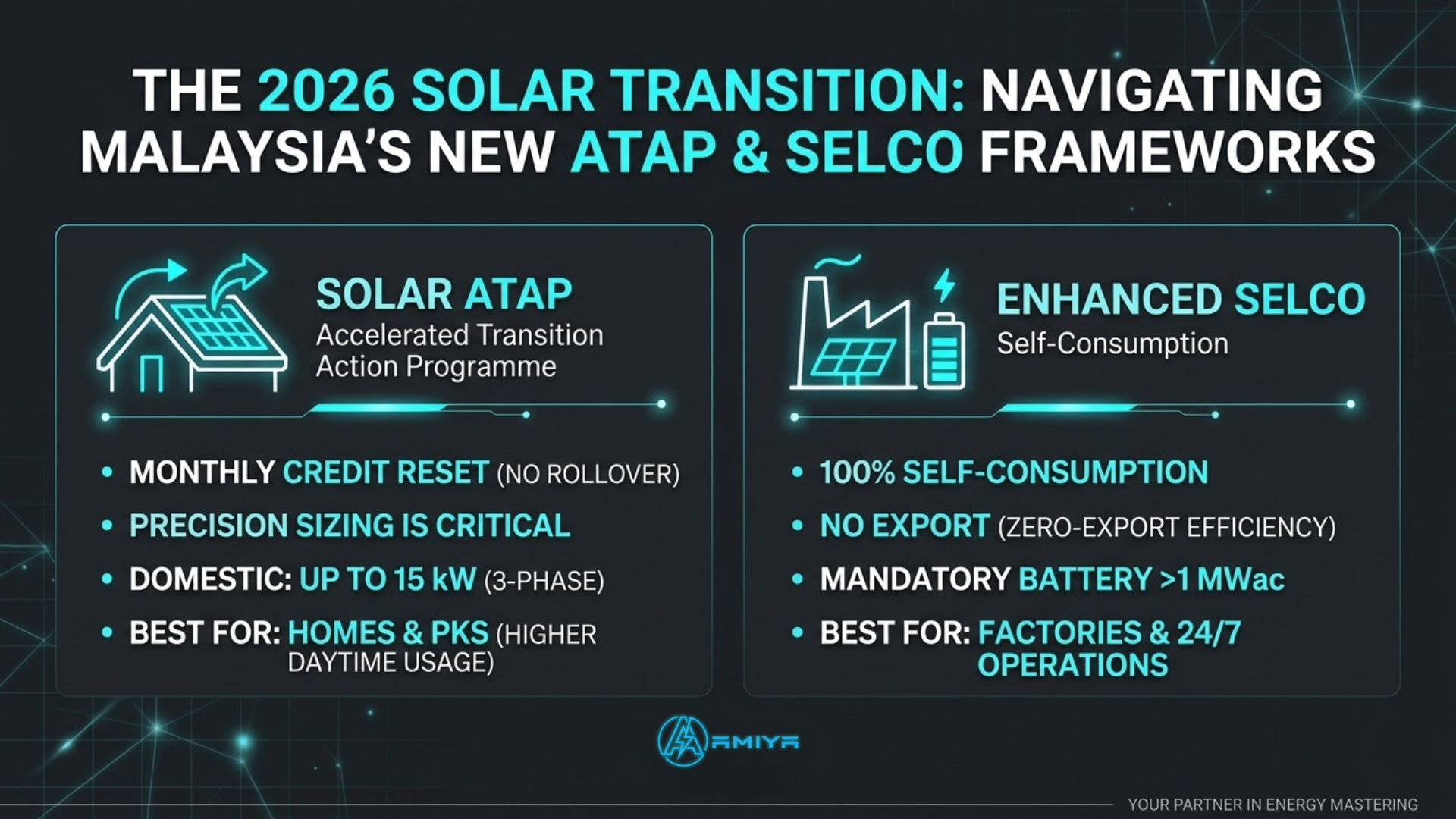
The Solar ATAP Malaysia 2026 (Accelerated Transition Action Programme) is the definitive new standard for residential properties and small-to-medium enterprises (SMEs). Launched on January 1, 2026, ATAP removes previous quota bottlenecks, offering a fluid and accessible entry into renewable energy.
Key Strategic Shifts:
The Monthly Reset: Unlike the old NEM 3.0 framework where credits could roll over for months, ATAP credits reset at the end of every month. Excess exported energy offsets your current bill, but it cannot be carried forward.
Precision Engineering is Mandatory: Because of the monthly reset, “Right-Sizing” is now the single most critical factor of your investment. An oversized system leads to wasted, uncredited power. At Amiya Energy, we engineer your system to be perfectly balanced with your unique consumption profile, ensuring clean efficiency and zero wasted value.
Optimized for EV Integration: Residential capacity limits have been increased to 15 kW for three-phase users. This is specifically designed to support the surging demand for high-speed home Electric Vehicle (EV) charging, turning your home into a self-sustaining fueling station.
Smart Home Synergy: Under ATAP, maximizing value means using power when the sun is shining. This pairs perfectly with modern smart-home ecosystems, allowing users to automate high-draw appliances to run during peak solar production hours.
2. SELCO: The Industrial Powerhouse
For heavy industries, manufacturing plants, and 24-hour facilities, SELCO (Self-Consumption) remains the undisputed gold standard for true energy independence.
Why Enhanced SELCO is the B2B Choice in 2026:
Direct Cost Offset: By consuming 100% of generated power on-site, businesses instantly bypass high-tier industrial tariffs and volatile Imbalance Cost Pass-Through (ICPT) surcharges. The ROI is immediate and highly predictable.
Mandatory Battery Integration (BESS): Under the strict 2026 guidelines, commercial systems exceeding 1 MWac are now required to integrate Battery Energy Storage Systems (BESS). This officially transforms solar from a passive daytime offset into an active, 24/7 operational asset. BESS allows facilities to store midday solar excess and deploy it during peak demand hours, effectively “peak-shaving” to lower maximum demand charges.
Carbon Tax Compliance & ESG: With Malaysia’s Carbon Tax actively targeting the energy and industrial sectors this year, SELCO provides a verifiable, immediate way to reduce your Scope 2 emissions (indirect emissions from purchased electricity). This not only reduces your tax liability but is crucial for satisfying the rigorous ESG requirements demanded by global supply chains.
3. The Role of Smart Monitoring and AI
In 2026, a solar system is only as good as the software managing it. The transition to Energy Mastery relies heavily on data. Modern inverters and energy management systems now utilize AI-driven analytics to forecast weather patterns, predict daily energy yields, and autonomously decide whether to deploy battery storage or draw from the grid.
This invisible, intelligent layer ensures that your energy infrastructure operates at peak efficiency without requiring constant manual oversight, providing a clean, professional user experience.
Framework Comparison at a Glance
| Feature | Solar ATAP | SELCO (Enhanced) |
| Target Audience | Modern Homes, EVs & SME Offices | Factories, Plants & 24/7 Operations |
| Excess Export | Allowed (Offset against monthly bill) | No Export (100% Self-Use Only) |
| Credit Rollover | None (Resets Monthly) | N/A |
| Max Capacity | Up to 100% MD (Capped at 1MW) | Based on Technical & Load Study |
| System Focus | Right-Sizing & Smart Automation | BESS Integration & Peak Shaving |