
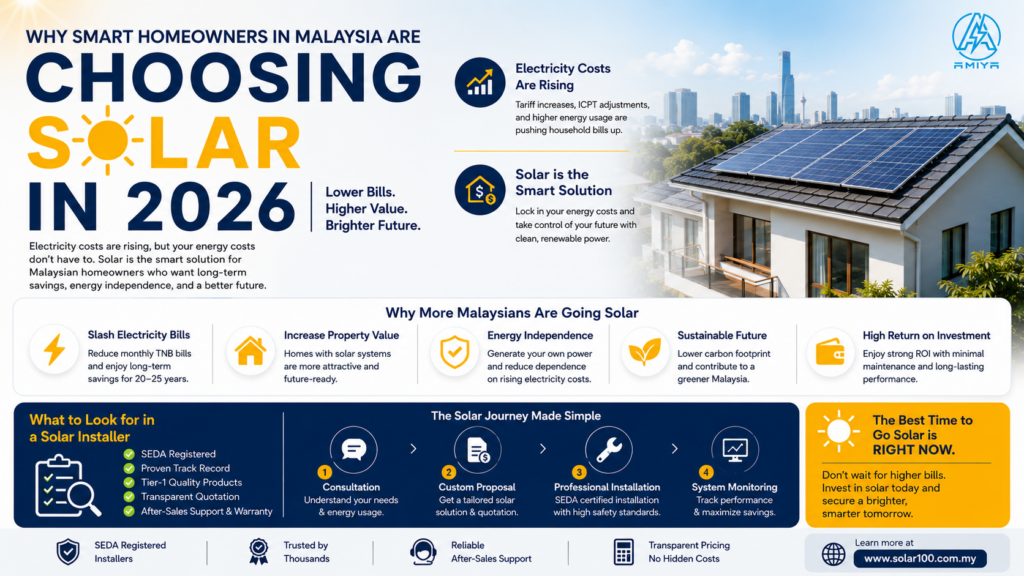
Solar Panel Malaysia: Price, Installation & ROI 2026 Guide
Solar panel Malaysia is rapidly becoming one of the most talked-about energy solutions in 2026, as homeowners look for ways to reduce TNB bills and secure long-term savings. It has evolved into one of the most talked-about financial and property upgrade decisions among Malaysian homeowners and commercial property investors.
Across premium residential areas in Kuala Lumpur, Johor Bahru, Shah Alam, and Penang, rooftop solar panels are becoming the new symbol of modern wealth — almost like owning an EV or smart home ecosystem.
What changed?
The answer is simple:
Electricity tariffs are rising, energy uncertainty is growing, and Malaysians are becoming more financially aware than ever before.
According to insights published by Solar100 Malaysia, homeowners are no longer viewing solar as merely an environmental initiative. Instead, solar has become a long-term wealth preservation strategy that protects households against future TNB tariff increases while significantly lowering monthly electricity expenses.
Malaysia’s Electricity Problem Is Quietly Becoming a Financial Crisis
For years, many Malaysians treated electricity bills as “normal household expenses.” But in 2026, the situation looks very different.
Several factors are driving the sudden surge in interest toward solar panel installation in Malaysia:
- Increasing TNB electricity tariffs
- ICPT adjustments
- Rising fuel and global energy costs
- Higher electricity consumption from EV charging
- AI devices and smart homes increasing daily usage
- Hotter Malaysian weather causing heavier aircond usage
The average landed property homeowner today is consuming far more electricity compared to five years ago.
A modern Malaysian household often operates:
- Multiple air-conditioners
- EV chargers
- Gaming PCs
- Smart appliances
- Water heaters
- Large refrigerators
- 24/7 internet and automation systems
As energy consumption rises, electricity bills become increasingly painful.
This is why searches like:
- “Solar panel Malaysia price”
- “Solar installer near me”
- “How much can solar save in Malaysia?”
- “Solar ROI Malaysia”
- “Solar ATAP 2026”
have exploded across Google and social media platforms.
Solar Panels Are No Longer Just “Savings” — They’re Financial Assets
One of the biggest mindset shifts happening in Malaysia today is this:
Solar is no longer seen as an expense.
It is now seen as an asset.
A properly designed solar PV system can:
- Reduce electricity bills drastically
- Increase property value
- Improve long-term home attractiveness
- Reduce dependence on TNB
- Create predictable energy costs for 20–25 years
Industry discussions highlighted by Solar100’s industry insights explain that many Malaysian homeowners are beginning to compare solar systems to investment products due to their strong long-term ROI potential.
Some homeowners are even prioritizing solar installation before renovating kitchens or upgrading interior design because the financial return can be significantly more impactful over time.
The Hidden Problem in Malaysia’s Solar Industry Nobody Talks About
While the solar industry is booming, there’s also a major issue affecting consumers:
Information overload.
Many Malaysians searching for solar quotations face:
- Huge price differences between installers
- Confusing technical specifications
- Misleading savings claims
- Unknown panel brands
- Unclear workmanship standards
- Weak after-sales support
For the exact same 10kW system, quotations can differ massively depending on:
- Panel quality
- Inverter brand
- Installation quality
- Warranty structure
- Cable standards
- Roof mounting materials
This has created what many industry observers describe as a “trust deficit” in the Malaysian solar market.
And honestly, the concern is valid.
A solar system stays on your roof for over two decades. Choosing the wrong installer can lead to:
- Roof leakage
- Inverter failures
- Unsafe wiring
- Poor ROI
- Weak customer support
That’s why homeowners are becoming more selective and research-driven before making any decision.
Why Smart Malaysians Are Comparing Solar Installers Instead of Choosing the Cheapest Package
In 2026, experienced homeowners understand one critical truth:
The cheapest solar package is rarely the best long-term investment.
Modern buyers are now prioritizing:
- SEDA certification
- Proven installation track records
- Tier-1 solar panels
- Warranty transparency
- Monitoring systems
- Long-term maintenance support
- ROI analysis
- Realistic savings projections
Platforms like Solar100 Malaysia are gaining traction because they focus heavily on installer verification, transparency, and customer education rather than simply pushing sales.
Their platform highlights several key verification areas including:
- SEDA registration
- SSM legitimacy
- Government incentive assistance
- Long-term maintenance support
- Transparent quotation processes
This trend reflects a larger shift happening in Malaysia:
Consumers want smarter energy decisions — not aggressive sales pitches.
Solar ATAP vs NEM: Why Malaysians Are Confused in 2026
One of the hottest trending topics in Malaysia’s renewable energy space today is the transition from older NEM schemes toward the newer Solar ATAP structure.
Many homeowners still search for “NEM 3.0 Malaysia” even though newer policy frameworks and energy strategies are reshaping how residential solar works.
The confusion often comes from:
- Old articles still ranking on Google
- Outdated Facebook information
- Installers using legacy marketing materials
- Misunderstood ROI calculations
Because of this, homeowners are increasingly searching for:
- Updated Solar ATAP guides
- Real ROI calculators
- Solar suitability checks
- Transparent savings simulations
Educational content such as:
are now becoming highly searched resources among Malaysian homeowners researching renewable energy adoption.
The Real ROI of Solar in Malaysia Is Bigger Than Most People Realize
Most Malaysians initially think solar savings only come from reducing monthly TNB bills.
But the true ROI is much broader.
A properly optimized solar system can potentially contribute toward:
1. Long-Term Inflation Protection
Electricity prices rarely decrease over time. Solar effectively “locks in” part of your future energy costs.
2. Property Market Advantage
Homes equipped with solar systems increasingly appear more attractive to younger buyers and environmentally conscious families.
3. EV Readiness
As EV adoption grows in Malaysia, households with solar systems gain a major advantage by offsetting charging costs.
4. ESG & Sustainability Positioning
Commercial properties adopting solar gain stronger ESG positioning, something becoming increasingly important for investors and corporate partnerships.
5. Energy Independence
Many homeowners simply prefer reducing reliance on fluctuating external energy costs.
Why 2026 Could Be the “Golden Window” for Solar Adoption in Malaysia
Several industry analysts believe Malaysia is entering a crucial acceleration phase for renewable energy adoption.
This is due to:
- Rising public awareness
- Stronger sustainability movements
- Increasing electricity costs
- Government renewable energy targets
- Growing EV ecosystem
- Better financing accessibility
- Improved solar technology efficiency
The reality is simple:
The longer homeowners delay solar adoption, the more cumulative electricity expenses they continue paying into an unstable long-term energy environment.
That’s why many financially savvy Malaysians are acting now instead of waiting.
Final Thoughts: Solar Is Becoming Part of Malaysia’s Modern Lifestyle
A decade ago, solar panels were viewed as something niche or experimental.
Today, they represent:
- Smart financial planning
- Energy awareness
- Modern property upgrading
- Long-term cost optimization
- Sustainable living
And in Malaysia’s increasingly energy-intensive future, that shift is only accelerating.
Whether you own:
- A terrace house
- Semi-D property
- Bungalow
- Shoplot
- Commercial building
- Factory
- Warehouse
the conversation is no longer:
“Should I consider solar?”
It’s rapidly becoming:
“How much am I losing by waiting?”
For Malaysians exploring trusted solar insights, installer comparisons, ROI guidance, and renewable energy education, platforms such as Solar100 Malaysia Official Website continue to emerge as one of the growing reference points within the local solar industry ecosystem.
Frequently Asked Questions About Solar Panel Malaysia
How much does a solar panel cost in Malaysia in 2026?
How much can solar panels reduce TNB bills in Malaysia?
Is solar panel worth it in Malaysia 2026?
What is residential solar panel installation in Malaysia?
How long does solar panel installation take in Malaysia?
What is the difference between Solar ATAP and NEM in Malaysia?
Are there financing options for solar panel in Malaysia?
What size solar panel system do I need for my home?
RM200 bill → 3kW system
RM400 bill → 5kW system
RM800+ bill → 10kW system
What should I look for in a solar installer in Malaysia?
* SEDA certified
* Experienced with proven track record
* Offering Tier-1 panels
* Providing strong warranty and after-sales support
What is the ROI of solar panel in Malaysia?
Why is solar panel trending in Malaysia right now?
* Rising electricity costs
* EV adoption
* Government renewable energy push
* Increased awareness of long-term savings