
Solar Panel Recycling: What Happens After 25 Years?
The most common question we get from clients about installing a renewable energy system isn’t about cost, ROI, or efficiency. Instead, it’s this:
“What happens to these solar panels in 25 years?”
It’s a highly valid and rational concern. Shifting to clean energy is meant to protect the environment; therefore, it shouldn’t create a future e-waste crisis down the line. If we truly champion sustainability, we must consider the end of a product’s lifecycle.
So, are solar panels destined for the landfill? The answer is no. Let’s unpack how the green energy industry handles solar panel recycling for the long term.
The Reality of a Solar Panel’s Lifespan
Generally, most commercial and residential solar panels come with a 25- to 30-year performance warranty. However, this doesn’t mean they stop working entirely after that period. They will still generate power, but their efficiency naturally decreases compared to when they were first installed.
When the time finally comes to replace or upgrade the system, the green energy industry already has a sustainable solution in place.
The Solar Panel Recycling Process: Recovering 95% of Components
The reality that many might not realize is that the solar industry is actively building a circular economy. The core components of a solar panel are not non-biodegradable, toxic materials; rather, they are valuable, highly recyclable resources.
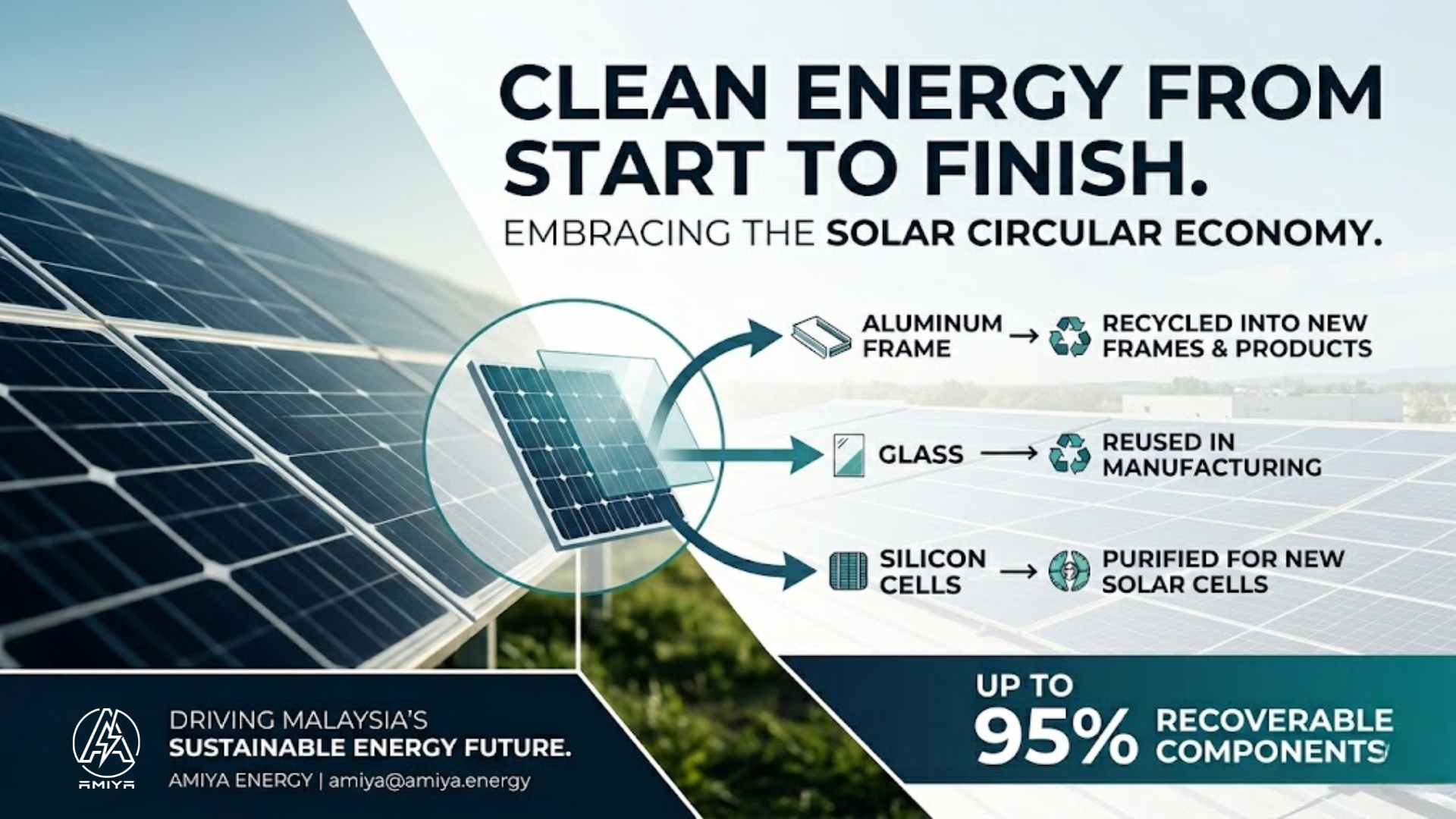
Through advanced processing technology, up to 95% of a solar panel’s components can be fully recovered, processed, and repurposed for new manufacturing. This process includes:
Glass: Making up the vast majority of the panel’s weight, this glass can be crushed, melted down, and used to create new glass products.
Aluminum: The panel’s frame is made of 100% recyclable aluminum, which can be infinitely melted and reused without losing its structural integrity.
Silicon: The solar cells themselves contain highly valuable silicon. It can be extracted, purified, and reused to manufacture electronic chips or next-generation solar cells.
Cables and Copper: Wiring components are carefully separated to recover copper, a highly sought-after metal with strong market value.
The Circular Economy in Renewable Energy
Transitioning from a linear economy (“take, make, dispose”) to a circular economy is the key to true environmental stewardship. By prioritizing solar panel recycling, we can:
Prevent the unnecessary depletion of the Earth’s raw materials.
Reduce the carbon footprint generated by mining and processing new resources.
Keep end-of-life solar technology out of local landfills.
This proves that solar energy technology is a comprehensive solution that remains green from its initial production all the way to the end of its life.
Amiya Energy’s Commitment to a Sustainable Future
At Amiya Energy, our ultimate goal is achieving true Energy Independence for our clients. We believe that true sustainability doesn’t end once the installation on your premises is complete. Environmental responsibility is a lifelong commitment.
That is why we are actively championing and supporting solar panel recycling initiatives right here in Malaysia. We are committed to ensuring that the advanced technology powering our present never becomes a burden on our future generations.
Clean energy should be clean from start to finish.
Curious to Learn More?
If you represent a company or business interested in how the lifecycle of a commercial solar system is responsibly managed, we are ready to help.
Contact Amiya Energy Today and let’s build a brighter, cleaner future together.